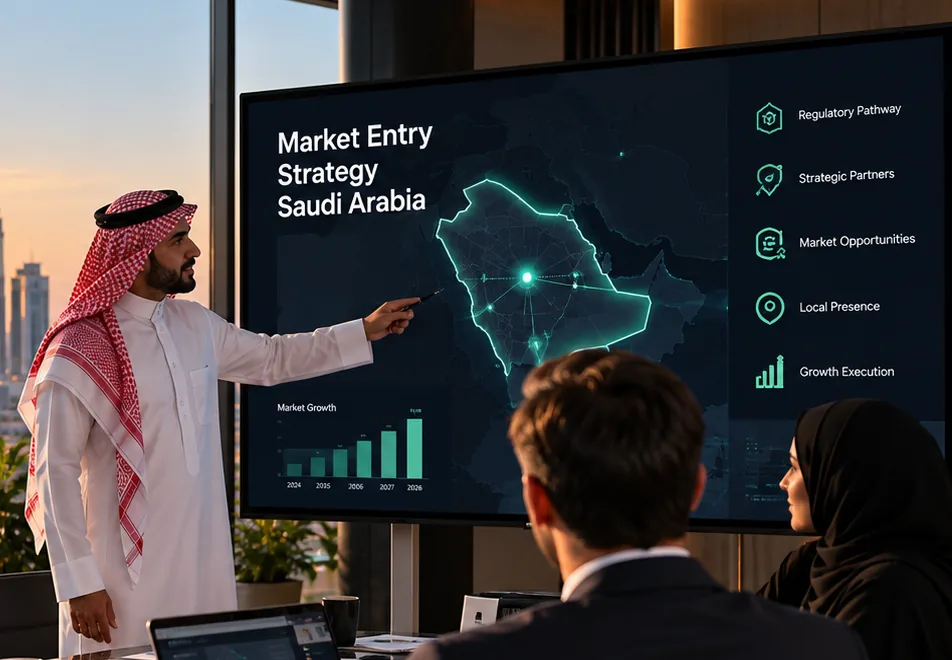
Swedish companies operating inside Saudi Arabia are, by their own account, doing well. Ninety-one per cent describe the business climate as good or very good, which is the highest score Business Sweden records anywhere in its Middle East and Africa survey group, ahead of Morocco at 72 per cent and the UAE at 71. Eighty-two per cent turned a profit last year. Three-quarters plan to invest more.
Now look at where Nordic exports actually go. About 74 per cent stay in Europe. The whole MENA region takes roughly 2 per cent.
Those two facts sit oddly together. The firms who went are thriving, and almost nobody else has followed them. Understanding why is the first useful question for any Nordic company thinking about the Kingdom.
The numbers
Swedish exports to Saudi Arabia came to somewhere between USD 1.4 and 1.5 billion in 2024, up about 5 per cent on the year before. Around 60 Swedish companies operate there, roughly 40 established directly and the rest working through local partners or agents. Saudi Arabia and the UAE have been Sweden's two largest Middle Eastern export markets for decades.
Put that USD 1.5 billion against total Swedish merchandise exports of more than USD 200 billion and the picture sharpens. The largest economy in the Middle East, in the middle of an enormous restructuring, accounts for well under one per cent of what Sweden sells abroad.
The Kingdom, meanwhile, is buying. EU foreign direct investment into Saudi Arabia reached USD 8.5 billion, about 17 per cent of the country's total inflows. The stated target is USD 104 billion a year by 2030, which would be 5.7 per cent of GDP, up from 1.5 per cent in 2021. Non-oil activity passed half of real GDP in 2023 and has kept climbing since.
The demand exists. Nordic firms are mostly not there to meet it.
Newcomers are outperforming veterans
The most useful figure in the Business Sweden data is one almost nobody quotes.
The standard advice on Saudi Arabia is that it takes years. Build relationships, serve your time, expect returns eventually. The survey does not support this.
Among Swedish companies that entered after 2019, 80 per cent reported a profitable 2024. Among companies established before 2003, the figure was 75 per cent. The recent arrivals did slightly better than the firms that had been there for two decades.
Every newcomer surveyed also said they intended to increase investment over the coming year, with no exceptions.
Business Sweden's own reading is that companies entering now tend to arrive with a clear strategy, and that this clarity, rather than tenure, is what produces results. The market rewards a well-designed entry more than a long one.
For a board that has been treating Saudi Arabia as a decade-long bet, that is worth sitting with. The evidence points the other way. Entry done properly pays back inside an ordinary investment horizon.
Where the friction actually sits
Companies inside the market are not complaining about the things people outside it worry about.
Personal safety scores highest among local conditions. Digitalisation comes second, with several respondents noting that the Kingdom has overtaken European markets on process automation. Distributor networks, physical infrastructure and the financial system all rate well.
The friction is somewhere much more specific. Ranked by dissatisfaction, the top three are labour market regulation, access to specialists and key personnel, and licences, permits and approvals.
Asked separately about trade barriers that materially hurt operations, respondents named local requirements (42 per cent), customs procedures (21 per cent) and navigating local regulations (18 per cent).
Nothing on either list is about corruption, political risk or cultural incompatibility. The obstacles are administrative and human. Saudisation quotas, licensing pathways, local content thresholds, permit processes, and competition for qualified Saudi nationals against public-sector employers with deeper pockets.
All of it is solvable. All of it is also slow and expensive to solve from Stockholm without capability on the ground.
One more operational point worth planning around: respondents consistently flagged that payment terms in Saudi Arabia run longer than European norms. That is a working capital question to design for, not a surprise to absorb later.
Three changes that reset the calculation
A good deal of what European executives believe about Saudi Arabia is simply out of date. Three shifts in particular have changed the entry maths, and any analysis resting on pre-2020 assumptions is now wrong.
The local partner requirement is gone. Foreign investors can own 100 per cent of a Saudi company. The old obligation to take a local sponsor, which was the biggest structural deterrent for most Nordic firms, no longer applies in the majority of sectors. One respondent in the energy sector put it plainly: permitting full foreign ownership has opened the market globally.
The RHQ programme now works as a procurement gate. Multinationals establishing a Regional Headquarters in Riyadh get 30 years of zero corporate income tax and withholding tax exemption, a ten-year exemption from Saudisation requirements, and unlimited visas for RHQ staff. Some 571 multinationals have already set one up, and over 40 per cent of Swedish companies with a local presence have done so or are in the process.
The incentives are only half of it. Companies that do not participate face restrictions on public procurement and government contracts. In a market where the state and state-adjacent entities do most of the buying, that is not a minor exclusion. The RHQ decision has quietly become a decision about whether you can sell at all.
Local content has become a pricing mechanism. The regime runs through IKTVA in the energy supply chain, the Made in Saudi programme in manufacturing, and government procurement rules generally. It is usually described as a compliance burden. It is also a commercial lever: firms meeting local content thresholds can charge 10 to 20 per cent more, depending on their score. Handled reactively it costs money. Designed into an entry strategy from the start, it becomes margin.
What actually drives success
Asked what has mattered most for staying competitive, Swedish companies in the Kingdom gave a consistent answer across every size and sector. Partnerships and relationships came first, then brand awareness, then cost efficiency.
Saudi Arabia is still a distributor-driven market, and the standard Nordic entry path reflects that. Test through a local distributor, establish a sales presence, deepen into services and support, then eventually move into local assembly or R&D.
The report is blunt about how this goes wrong. Identifying the real decision-makers from abroad is very difficult. Market data is often unavailable or unreliable. Decision-making structures are opaque from outside. Trust gets built in person and slowly, and dropping a distributor badly can damage a reputation that took years to build.
There is also a competitive shift that Nordic firms tend to underweight. The survey notes a growing Chinese presence, which has made cost efficiency and brand differentiation matter considerably more than they did five years ago. The period when a European brand could win on reputation alone is closing.
It has not closed yet. Ninety-one per cent of Swedish companies say the Swedish brand actively helps their business, with a quarter calling the effect significant, up 14 points year on year. Quality, innovation and long-term reliability still carry real weight in the Kingdom.
The advice buried in the report
One line in the Business Sweden report deserves more attention than it gets. On handling long payment terms, opaque procurement and the difficulty of establishing credibility with Saudi buyers, the recommendation is to adopt asset-light strategies and develop joint proof of concepts with customers, both to demonstrate commitment and to smooth transactions.
That is a fair summary of the whole problem and its solution.
Companies that struggle tend to treat Saudi entry as a binary. Either commit serious capital to a full establishment, or stay away. Companies that succeed structure entry as a sequence of proof points instead: a validated pilot, a demonstrated commitment, a local presence sized to the traction they have actually achieved.
On this evidence, that is not a compromise. It is the method that works.
What it means if you are weighing Saudi entry
Four conclusions follow from the data.
The market is under-served by Nordic firms, and the ones who are there are doing well. A 2 per cent MENA export share alongside a 91 per cent satisfaction rate is not a stable equilibrium.
Tenure is not the barrier. Newcomers out-earned incumbents, which suggests the constraint is knowing what you are doing rather than how long you have been doing it.
The obstacles are administrative. Licensing, Saudisation, local content, permits, decision-maker access. Every one of them can be solved, and every one of them costs more to solve from Europe.
The window is open but it is being priced in. 571 RHQs, intensifying Chinese competition, local content shifting from preference to requirement. First-mover advantage in the Kingdom is real and it is finite.
Whether Saudi Arabia is a viable market is no longer an open question. The companies already there have answered it. The open question is whether you enter with a validated strategy and execution on the ground, or the way most first-time entrants do, spending two years learning what the data above could have told you at the start.
About the data
Figures come primarily from the Business Climate Survey for Swedish Companies in Saudi Arabia 2025, published by Business Sweden, which surveyed 34 Swedish companies operating in the Kingdom during January and February 2025. Additional figures are drawn from the Saudi Ministry of Investment (MISA), the Saudi General Authority for Statistics (GASTAT), Sweden's National Board of Trade (Kommerskollegium), and Transparency International.
A note on scope: the richest primary data on Nordic commercial experience in Saudi Arabia is Swedish. Where this article says Nordic, the underlying survey evidence is Swedish, and readers in Denmark, Norway and Finland should treat the findings as strongly indicative rather than directly measured. The structural conditions described here, including ownership rules, the RHQ regime, local content requirements and Saudisation, apply to all foreign entrants regardless of where they come from.